Blogger Template by Blogcrowds.

Rodeo

Wednesday, March 13, 2013
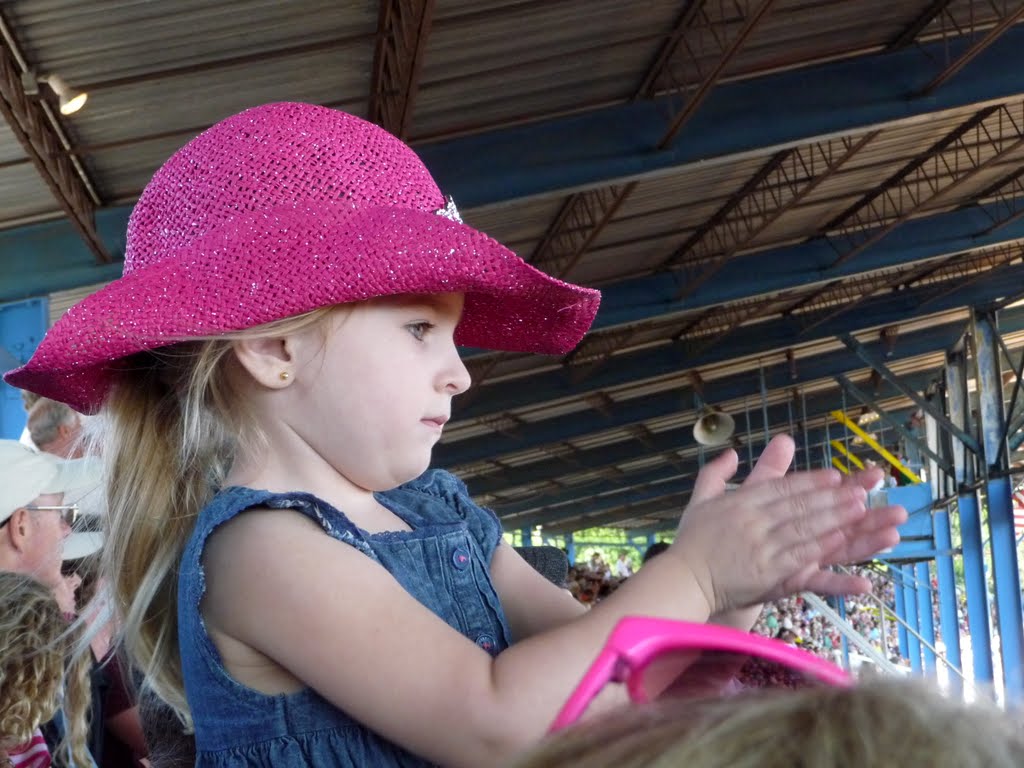
Last weekend, I went to the All-Florida Championship Rodeo in Arcadia, which is a cattle town in Central Florida.  Attending the event with me was my oldest son, his wife, and daughter.  This was to be the first rodeo experience for my granddaughter, Gianna, so I tried to enjoy it through her eyes.

The day was perfect for a rodeo with low humidity and temperature around 25 C.  The crowd was comprised mostly of pensioners from retirement communities in the area and local families with school-age children.  It began as most American events with a display of patriotism.


We were first treated to bareback riding of the broncos.  For my international followers, broncos are horses that have not been 'broken' to carry a rider.  As a pilot, we learn of the Flail Response in which a person cannot control his body when experiencing strong acceleration.  I surmise that this cowboy was pulling significantly more that 3 G's.


In steer wrestling, the cowboy is to dismount from his horse at full gallop, grab a steer by the horns, and wrestle the beast to the ground.  It seems fundamental to accurately match the speed of the cow as it accelerates out of the chute.  The wrestler has a wing man who helps him to corral the animal; however, the bovine sprinters were particularly spry and often left the cowboys in their wake.


When the wrangler was actually able to grab the fleeing steer, it was not always a pretty sight, as he dropped the cow to the ground.


In the steer roping event, the pair of cowboys had somewhat better success since they could subdue the fleeing steer with their lariats.  In order to be scored for the competition, one rider had to get a lasso around the cow's neck while the other cowhand roped a hind leg.


This technique worked better than just jumping from your mount and grabbing the cows head, albeit it was significantly less bravado.  The last roping event involved calves.  This seems unduly cruel since it involves scaring the heck out of a baby cow, but it had its own set of requisite skills.  Ideally, the calf was to be lassoed in order to bring it to a halt, but this was problematic.


Those wily young cattle were often very fleet of foot.  When this bovine ballet made it to completion, the rider rapidly tied the feet of the calf while his clever horse kept the tension on the rope around the calf's neck.


The cattle left the spotlight to make way for a little equestrian fanfare.  A team of 'horse dancers' performed a precision choreography known as quadrille.


The events were completed with saddled bronco riding and then bull riding.  As with most performances, they save the best for last.  Bull riding demonstrates that very large performers can be very light on their feet.  As soon as these 1400 kilo divos exit the gate, they enter into a whirling dervish with the intention of jettisoning the hapless rider as soon as possible.  Few riders managed to stay on the animal's back the required 8 seconds to score points.  Often the bulls required distraction by rodeo clowns to keep the angry beasts away from the downed rider.

At dusk, the animals had their favorite time of the whole day as they lined up to be transported back to their paddock for food and an unencumbered run.


Rodeo started in Spain but is popular in North and South America, as well as Australia.  The skills that are highlighted are mostly those that traditional cowboys needed to herd and move cattle.  Horsemanship is presented in a very practical way that differs from the fine art of equestrian competitions, like ice hockey differs from figure skating.  It captures some of the romance of the American West that formed a large part of our history.

Cynics may consider it to be toying with our food, like bull fighting in Spain and Latin America.  To get a fresh perspective, I asked my granddaughter what she thought of the proceedings.  She said, "Poppi, I don't like the way those men are mean to the cows".  Yee Haw, Buckaroo!!

Redemption!

Saturday, February 9, 2013
After uncertainty and frustration in 2012, I am pleased that 2013 is beginning auspiciously for my family and me.  In addition to the completion of treatments for my wife's illness, I have recently been hired by a new enterprise that is pioneering new technologies in renewable energy.  The lead project will be a small, offshore, commercial hydroelectric generating station that utilizes the flow of ocean currents and tides.


I have been retained in a creative, not managerial capacity.  I shall be the naval architect and industrial designer in the product development team.  The U.S. headquarters of the company is in Lakewood Ranch, which is in Florida's High Tech Corridor.  Our research consultancy is in Europe, so it will entail some international travel.  I am excited about the prospects for the future of the company and that I shall be able to play a role in developing this burgeoning technology.

The new position represents something of a personal redemption for me.  For most of my life, I have designed, engineered, and built yachts and and luxury accommodations.  Although results were often magnificent, they did squander significant resources for a select few.  I enjoyed the challenge of creating and coordinating the unique contributions that brought the projects to life.  Now, fate has handed me with a very different design and engineering challenge.  The success of this venture will result in the creation of carbon credits for good, old Mother Earth.  It will be nice to pay it forward for a change.


You Go Girl!

Monday, October 1, 2012

This is a tribute to my wonderful wife, Tiki.  She is pictured here in front of the Cliffs of Mohr on the west coast of Ireland.  This was a happy moment during a great trip.

Recent times have been darker.  She has just completed her last session of chemotherapy in a third bout with cancer.  I am proud to say that she has come through this latest struggle with flying colors!

After several years of travel and adventures in foreign lands, 2012 has posed a special challenge for us.  My first full year back in the States started with the passing of my Mother and then segued into a war with cancer in Tiki's latest fight.  To make matters worse, her Mother fell gravely ill while Tiki was in the middle of her treatments, which obviated a journey across country by Tiki to rally her siblings.  Fortunately, her Mother has since gained some ground.

We are not completely through Tiki's therapies but the worse is over.  She is a great fighter!  We look forward to putting this year in the rear-view mirror and to having new adventures in the future.

New Discount for My eBook, Fire Erzu of Qi' Lam

Wednesday, March 28, 2012


With the advent of 2012, I am discounting the price of my first ebook from $4.99 to $2.99.  Sales were up during 'Buy an eBook Week' in early March, so I have decided on a permanent price reduction.  Now, those of you who have procrastinated in acquiring a copy may go out and download today.  The best site to find my book is https://www.smashwords.com/books/view/44005

When you read the adventure, please join this blog and post your comments.  I am working on the sequel to The Fire Erzu of Qi' Lam now.  Since I am creating the new manuscript for you, I want to be aware of your likes and dislikes.  Keep me informed with your feedback.

Enjoy the adventures of the Loxu in The Fire Erzu of Qi' Lam!  Cheers!


Short Track Auto Racing in Rural Central Florida

Monday, November 21, 2011
In the end of October, we enjoyed spirited automobile racing at the DeSoto Super Speedway near Bradenton, Florida.  The races took place at night on a 3/8 mile (0.6 km) long track with a 12 degree bank.  Most of the competitors and spectators were local 'Good Ol' Boys' from Manatee and the adjacent counties. [For your information, a 'Good Ol' Boy' is defined in 'How To Speak Southern' as a fellow who enjoys corn liquor, boon companions, and buxom women but not necessarily in that order.]  The evening was full of noise, beer, stadium food, and colorful fans...A real hoot!

The races included a number of classes including trucks, cars of yesteryear, bombers, outlaw modified, sprint cars, and school buses.  The most entertaining were the latter two.


Sprint cars are extremely lightweight, open-frame vehicles with large power-to-weight ratios.  They reach speeds of up to 140 mph (225 kph) with engines that output around 630 bhp (470 kwh)!  They are so stripped down that they have no starters or batteries and have to be pushed to crank.  The cars race with an alcohol fuel that is mechanically fuel injected into the engine.  For safety, they have a roll cage and the enormous wing.  The wing holds the car down onto the track and is outfitted with sideboards that help with cornering.  The wing also provides protection to the driver in the event of a rollover.  The sprint cars were undoubtedly the loudest, smelliest, and fastest vehicles racing that night.  I am proud to say that my nephew, Greg Alexander, is an emerging star of sprint car racing in California.  We wish him the best of luck and safe racing!


Behind the truck in the foreground was one of the competitors in the school bus race.  The bus race is always saved for end of the night.  The buses have all of the seats removed and the driver is enclosed in a protective cage.  The unique feature of this particular event is that the buses compete on a figure-eight track.  As they progress through the twenty-five laps, there are hair-raising near misses between the leaders and the stragglers at the intersection in the course.  All the spectators were out of their seats throughout this race because it was very exciting watching the big vehicles blasting along at breakneck speeds.


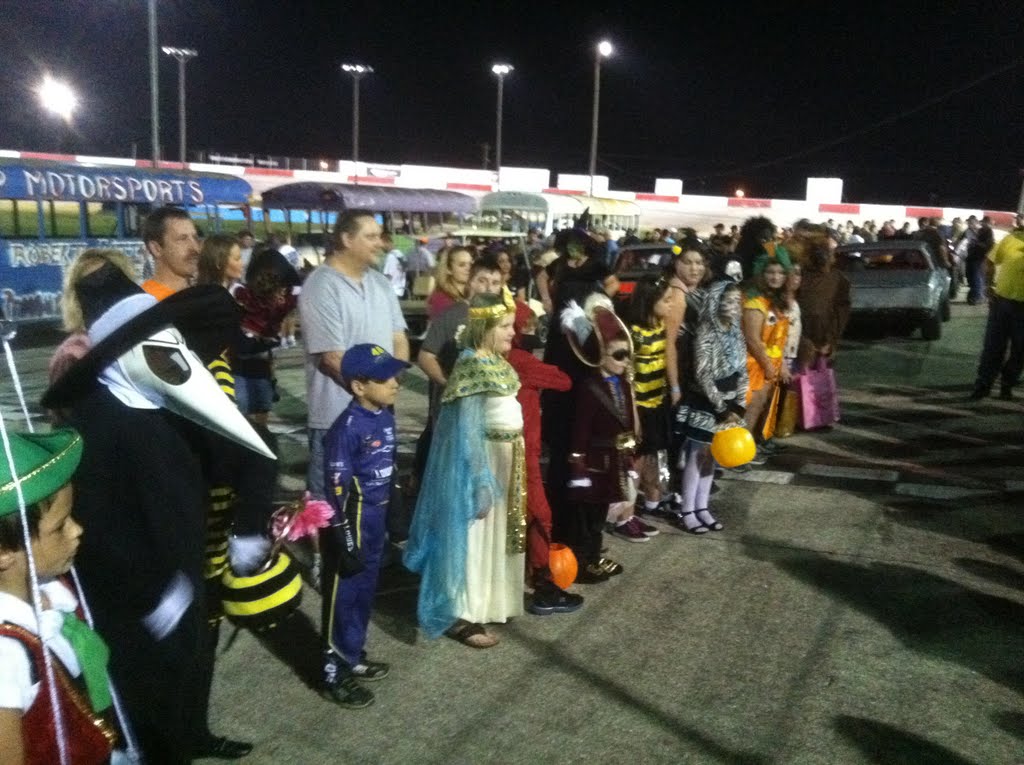
The night of racing coincided with the holiday of Halloween.  To mark the occasion, the drivers parked their cars in front of the grandstand and passed out candy and treats to the kids, who came in costume.  There was a costume contest as well and the winners received trophies that were similar to those awarded to the victors of the races.  It was great fun!  It also filled the stands with parents and their children which provided a change from the usual hard-core racing crowd.

Most of the world is familiar with the major sporting venues of the United States; however, the local and regional competitions like motor sport events and minor league baseball provide visitors with unique insight into the American culture.  I highly recommend attending if you are able.

Firehawk Designs

Friday, October 28, 2011


We are please to announce the advent of Firehawk Designs, where we create furniture and interior appointments for homes, offices, and yachts.  You are invited to visit our site on Facebook to learn more about us and to peruse photographs of past projects.

Our studio is a continuation of the type of work that I did during my time in the Middle East.  Even though the U.S. economy is weak, people are still improving their homes and boats through re-modeling and upgrading.  What we do is provide alternatives and solutions that are beyond the offerings of commercial retailers.  To date, we have received a very positive response to our offerings.

One of our hallmarks is our flexibility.  Since we are a relatively small operation, we may travel to your project to assess your wishes.  We may create your pieces with one of our local shops.  However, we shall also work with your interior designer and/or your cabinetmaker, if you are most comfortable with this arrangement.  We tailor our input to your requirements.

We would welcome your patronage, your referral to friends and family, and/or your endorsement to the building contractors and interior design professionals with whom you work.

Dragon Boats

Tuesday, August 9, 2011

I have been a little lax in keeping up with the posts since my recent departure from the Emirates.  I confess that I have been busy looking for a gig and promoting my book here in the States.  (I hope that your are all downloading copies.)

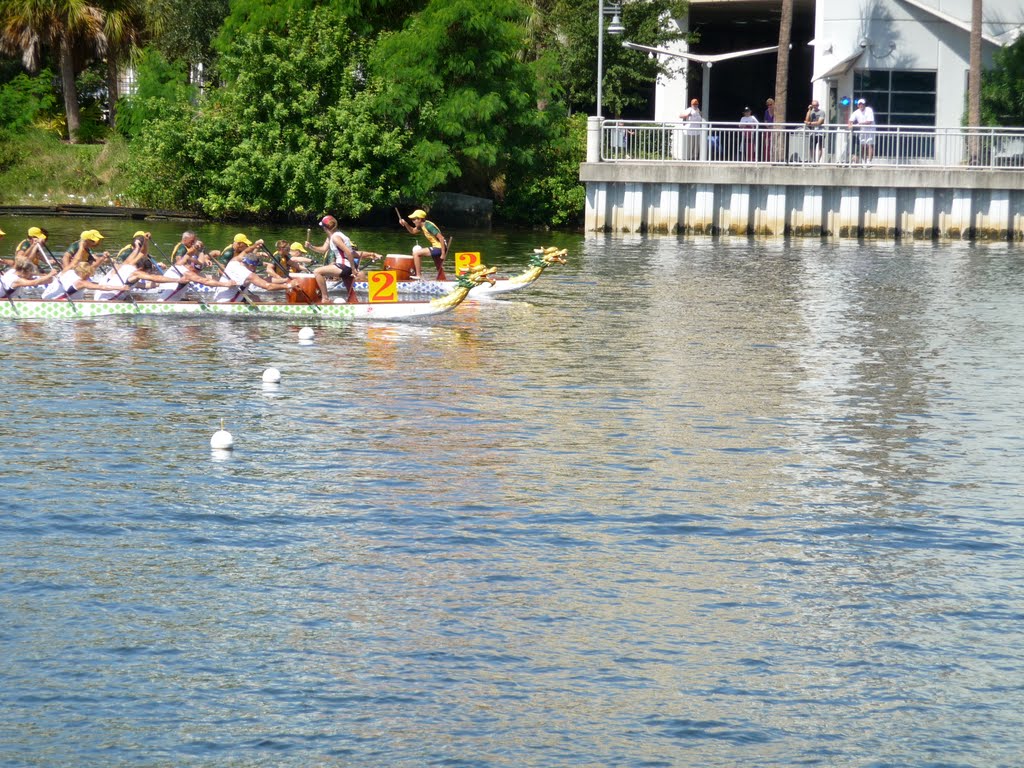
We recently had some international culture here in the Bay Area in the form of the 10th IDBF World Dragon Boat Racing Championships.  This biennial event took place on the canals of Tampa this year.  It attracted over 2,000 competitors from 17 countries.  I viewed dragon boat races in Dubai but it was great fun to watch them in my own 'backyard'.

For those of you who are unfamiliar with the sport, a dragon boat features a drummer in the bow to keep the cadence and a helmsman in the stern to steer with a sweep.  Between these two are a crew of 20 paddlers for the standard dragon boat or 8 paddlers for the 'baby dragon' boat.  The originated in China over 5000 years ago where they have been used for spiritual and competitive purposes.


They are usually festively adorned with features of their namesake.  These modern racing shells are lightly built from fibreglass but the traditional boats were carvel constructed like sampans and junks.

 
It is a very ecumenical sport for competitors of all ages and sexes.  Obviously, it promotes and relies upon teamwork, like most rowing sports.  Entrants ranged in age from late teens to seniors over 60, who paddled in a number of divisions.  As in Olympic events, there was great effort expended by the participants who proudly represented their countries.


Competition was often close!


Medal ceremonies followed the finals.  In contrast to other international sporting events, many of the winners were not from the large Western nations.  It was refreshing to hear the anthems of nations like the Philippines and Trinidad/Tobago as frequently as the European and North American national hymns.


If you ever have an opportunity to watch a competition, you will not be disappointed.  Better yet, go paddle a dragon boat yourself with your friends or co-workers.  You do not have to be a national champion to have a good workout and a whole lot of fun.  Check the Web for local groups.  Usually, your only investment is a good paddle and dues, since the boats are owned by the clubs.

Back in the U.S.A.

Friday, June 3, 2011
After five weeks back in the States, I am feeling like a Yank again for the most part.  It has been good to awaken on my own instead of being prompted by the calling of the muezzin at the nearby mosque to join in morning salah (prayer).  The weather in Florida has been pleasantly mild compared to the Emirates.  Daytime highs here have been around 90 degrees Frank with fifty percent humidity instead of 40 degrees Carl (104 degrees Frank) with the same or more humidity.

One of the major adjustments has been to the "measurement thing".  The U.S.A. is so big and powerful and so far away from everywhere else that it can keep its Olde English Imperial units.  After living and breathing the metric system for two years, I find that I am constantly converting from kilometers to miles and from degrees Carl to degrees Frank.  If I am still here in a couple of months, I shall probably be able to think like an American once again.

The other change that I am encountering is going from British to American.  There were very few Yanks in the Emirates, so I often found myself defending the U.S.A. against the onslaught of quips from Brits, Aussies, and Kiwis.  It was all in good fun, but now I am in the process of purging the elements of the Queen's English that have made their way into my vocabulary.  I was looking at a print ad for a Chevrolet Corvette Z06 and I found myself mentally pronouncing it as "Zed Nought Six".  I have a ways to go.

A significant difference concerns money.  With greenbacks in my wallet again, I have to stop thinking about values in dirhams.  In the Emirates, dollars were referred to in the news media but the most common foreign currency was definitely the Euro.  A unique feature of the U.S. dollars is that all of the notes are virtually the same color.  This is quite unique.  In most countries that I have visited, different denominations have distinct colors.  This helps illiterate residents and daft foreigners immensely since it is much easier to pass a clerk "two blue ones and one red one" instead of the actual face value.

Most Westerners who drove in Arabia described the drivers with adjectives like lunatics and idiots.  They confessed how they felt that they were endangering life and limb whenever they got into the car.  My immediate impression after two years in the Emirates is that driving is much more dynamic there than in the U.S. and Europe.  Here, we spend our time on the road going from one traffic stop to another.  It seems that we are standing still more than moving ahead.  In the U.A.E., there are relatively few traffic lights and numerous roundabouts so intersections seldom represent stop-and-go situations.  Traffic flow is controlled with huge speed bumps.  It was not an ideal system but it seemed to progress better.

My day-to-day existence since my return has been working on our house, looking for a new gig, and promoting my newly published book.  I have been incredibly busy.  I am ready to launch into a new routine wherever life decides to lead me.  My friends who have read my book have optimistically told me that I may be able to stay at home and write for a living.  Realistically, I believe that I shall be back in a job here or abroad.  I am fine with most scenarios so long as I can continue having adventures and am able to spend time with my wife and family.

Changes in Longitude

Tuesday, April 19, 2011
My gig in Dubai has ended rather abruptly and I am heading back to America soon.  The company for which I have worked had a couple of big projects 'go South', so senior management is having me 'go West' back to the States along with my salary.

Before returning to the U.S.A., I thought that it would be best if I explored job options here in the Emirates.  Ship construction is virtually dead here unless you are building a dhow like this one.


Keeping an open mind, I thought that it would be best to investigate employment options in other fields.


This seemed to be a position that offered plenty of fresh air, sunshine, and all the salt that you could use, but the benefits and compensation were lacking.


I thought that working with animals may be an interesting change.  However, the smell that you acquire by living in a close proximity to camels compromises your social options with humans.


The water taxis seemed to be a way to stay in boating but with a fare of one dirham per ride it would take many trips to pay the mortgage.  Besides, my fluency in Malayalam and Tamil is not adequate to converse with the other watermen.

I shall have to cast my fate to the world market once again.  I have opportunities to explore in the States and abroad.  I shall miss many of the people with whom I have worked and flown during my tenure but I should be able to keep up with them through e-mail and Facebook.  I have had a good run for the last two years and enjoyed the adventure.  Although the Emirates have not had any insurrection, my family will be glad to have me home, since I have been in living in an unstable part of the world.

Pimp My Ride

Friday, April 1, 2011
Many are familiar with this expression.  American television has many offerings showing custom shops modifying vintage Chevies, Honda Civics, BMW's, AMG Mercedes, and a whole range of other automobiles.  Since the car is as much a vehicle for self-expression as for transport, it has become the perfect medium for many to demonstrate their creativity.

Here in Dubai, we have a good number of decked-out German automobiles and SUV's that you could view in the parking lot of any mall or nightclub.  However, we have an influence from the sub-continent due to large number of ex-patriot Indian citizens.  Their expressionism takes on a different form.


Virtually all of the 'pimped' vehicles are trucks.  They may be seen plying the roads loaded with everything from camels to freight.  Some of you may think that this has the flavor of Mexican ornamentation.  However, the tassels and sheet metal are distinctly eastern and some have religious significance.  It is great to see how the drivers personalize their utilitarian rides.

Remember that many of the commercial haulers are not limited to the roads here in the Emirates.  Self-expression extends to the waterways.


Since many waterman both live and work on the dhows, 'pimping their ride' is also a form of home beautification.

FIRST BOOK PUBLISHED!

Tuesday, March 15, 2011

I am proud to announce that I have published my first novel.  The e-book is available for immediate download to your Kindle, iPad, Sony Reader, Kobo, iPhone, Android, PC, or Mac at http://www.smashwords.com/books/view/44005 In a few weeks, you may also acquire the book at the on-line sites of Barnes and Noble, Borders, Apple, and Amazon.

The book is a work of adventure, science fiction.  The story is not set in deep space but is a very down-to-earth tale of a young traveler who uses his skills and intelligence to manage and rise above an impossible set of circumstances.  The book holds appeal for many readers and includes travel, invention, sport, romance, fighting for freedom, the love of family and friends, and a whole lot of flying.

The ideas for the book were spawned while soaring on thermals above the pastures of Central Florida.  I began the story in Saint Petersburg, Florida.  After two-and-a-half years of writing and editing, I completed the manuscript here in Arabia.  In all phases of the project, I turned to the skies for inspiration; however, in the Emirates, I have traded a glider over flat farmland for a microlight between the Hajar Mountains and the Gulf.

As an e-book, my manuscript is very reasonably priced.  You may acquire the work for less than the cost of one gallon of fuel in most of the world.  You could even give it as a gift and really become a patron of the arts.

After you have read the story, please write a brief review (hopefully a five-star accolade) on the Web site of the retailer.  This insight is of great value to others who are contemplating whether or not to acquire my manuscript.

Remember to tell others about the Fire Erzu of Qi' Lam and explain how they may purchase and enjoy the story.  For us indie publishers, we depend on you, our readers, to spread the word about our works.  May my story go viral!

If enough of you savor the work, we may convince the influential gentlemen of Hollywood to create a film from the book.  It would make an exciting movie!  To date, most folks are thinking of casting Liam Neeson in the role of Seripovo.  (You will have to read the book to decide whether or not you agree.)

Thanks for indulging my blatant self-promotion.  I need inspiration to continue with the sequel, The Third Race.

And They're Off!

Wednesday, March 2, 2011
One beast that is highly revered here in the Emirates is the camel.  They are lovingly raised for meat, milk, and racing.  Today, we shall have a look at the kyphotic thoroughbreds.


The race season here takes place during the cooler winter months on most Fridays and Saturdays.  The camels run on large courses that consist of concentric tracks bordered by a paved road.  The reason for the concentric circles is that camels will not cross a start-finish line like a horse and this way they are able to always run on a new section of the track.


The roadway adjacent to the track enables control of the running beasts.  Many years ago the jockeys were small, young boys of around five years of age from the subcontinent.  Since child labor is rather out-of-fashion, the jockeys are now radio-controlled, cordless drills with a whip connected where the bit would normally be placed.  Under those flashy silks is the lionheart of a Makita or a DeWalt.  The owners of the camels follow them in air-conditioned SUV's and spur them on with the electric jockey when necessary.

Camels can be unruly so there large numbers of handlers to control them, warm them up, and get them to the course on time.  Even so, sometimes they just insist on stopping and squaring off with another competitor.


When they run, they have a loping, splayed gate that is not too graceful.  The ungainliness does not prevent them from achieving speeds of up to 65 km/h.  This is very impressive since camels are most often seen moving very slowly in the desert while they conserve energy and keep their metabolisms low in the extreme conditions.


Camel racing takes place in most of the kingdoms of the Arabian Peninsula.  The owners are primarily royalty who spare no expense on these champions of the sand.  Individual animals have sold for several hundred thousand dirhams at auction.  Here it is truly the sport of kings.

Merits of A Mini-Vacation

Thursday, February 17, 2011
I apologize to my readers for being remiss about posting to the blog.  I have been working on getting my novel published.  (It will be coming soon to an e-book store near you.)  With a J-O-B for six days each week, there is only so much time left for W-R-I-T-I-N-G.

My wonderful wife visited me during January and we took a three-day, mini-vacation.  My work load did not allow for the usual week, but we made the most of our time off.  After a fifty-minute flight over the Hajar Mountains from Dubai, we landed in Muscat, Oman.  We proceeded directly to the Chedi Hotel, which is a GHM resort located on the shores of the Gulf of Oman (Indian Ocean).


We then spent three, vigorous days of doing nothing.  The hotel had many cozy locations where the sun and fresh trade winds could be enjoyed.


There were two, infinity swimming pools with staff anxious to tend to your every wish.


The dining was absolutely top shelf with cuisines varying from Arabic to Indian to continental.  I cannot consume the quantities that I enjoyed when I was young; however, I am better able to savor the smells and tastes of scrumptious food when accompanied with fine wines and coffees in an elegant setting.  We definitely liked the catering.


When we were ready to return to Dubai, we were well-rested--physically, mentally, gastronomically, and emotionally.  I felt much better equipped to face the stress and deadlines of my work.

I realize that everyone cannot just pick up and jet off to Oman, but the merits of a similar vacation may be realized elsewhere.  Plan a journey that takes you at least a hundred kilometers from your home to a location where you and your significant other may savor quiet private time without interruptions.  The relaxation and rejuvenation will have tangible results.

Family or group holidays have their rewards, but the hassles of the preparations and logistics in getting underway may add to the stress that you are seeking to leave behind.  Furthermore, you are being controlled by events and the expectations of others which reduces the spontaneity.  At times, it seems like a relief to get back-to-work.  This is hardly the desired outcome.

Consider the merits of a mini-vacation.  Do nothing but what your heart desires.  You are worth it.

Cricket

Friday, December 31, 2010
After living with Indian ex-patriots for almost two years, I have three conclusions about the British influence on the sub-continent.

1. The greatest thing that the British got from the Indians was tea.
2. The greatest thing that the British did for themselves while they ruled India was develop India Pale Ale for their troops.
3. The greatest thing that the Indians got from the British was cricket.

For the American readers, cricket does not refer to the soothing insect that chirps after twilight and is great bait for trout.  It is a sport that is played with a bat and a ball.  It never caught on in America, perhaps because it is akin to slow baseball.  It is hard to imagine anything slower than baseball.  A British pundit described the American reaction to cricket as "How can I hit the ball when I'm so busy eating grits and seeing my psychologist?".

The Indians and Pakistanis are absolutely passionate about cricket and have brought their love for the game wherever they have settled.  When we first acquired satellite television in America, we inquired about the pay-for-view sports packages.  The salesman for the broadcast company informed us that the most popular package by far had nothing to do with the NHL, NBA, NFL, or NASCAR.  It was cricket.


The photo illustrates a typical cricket game in the Emirates.  This is an empty lot on the side of the Emirates Highway in Sharjah.  Every Friday, this pick-up game is played in the morning.  The Indian workers in my company play every day at lunch.  Apparently, all that is required is a strip of hard ground for the pitch and a patch of desert.

My British and Aussie mates talk a good game of cricket.  There has been much vocalizing recently while the UK has been shellacking the Australians during the Twenty20 World Cup.  They hold strong opinions but during my time here, I have never witnessed ex-pats from the UK or Down Under playing the game.

If you are interested in the nuances of the game, I refer you to Wikipedia where you may learn the differences between 50 over and 20 over matches.  If you want to feel the passion of the sport, watch one of the very non-professional games played by Indian laborers.  It is a focus of their often poor and dreary lives.

Postscript...Something Cool


This has nothing to do with cricket.  I snapped this mediocre-to-poor photograph from the cockpit of the microlight aircraft that I was flying 1000 feet above the Gulf on this unusually clear morning.  The white spots are a huge pod of dozens of bottlenose dolphin that were herding fish ahead of them.  It was a magical moment!

A Proper Christmas Lunch

Saturday, December 25, 2010
MERRY CHRISTMAS from DUBAI!


Today, I feel a little like the Jewish toy merchant who celebrated a successful retail season by taking the family to Antigua while the Christians had their Christmas in the cold.  This Christmas morning dawned brightly in Dubai to a cool 19 degrees C. (66 degrees F.).  I watched the world news with a cup of coffee to learn of record chill and snow in Europe and North America.  Air travel was suspended in many locations and snow was anticipated as far south as Atlanta, Georgia.  Brrrrr!

After a good swim under the bright Arabian sun, I dressed and walked the half kilometer from my flat to the Irish Village Pub in the Aviation Club.  The temperature had warmed to 26 degrees C. (79 degrees F.) and it was perfect for a meal in the garden.  For a reasonable sum, the pub was hosting a Christmas buffet lunch with all the trimmings.  Fortunately, I had not eaten anything before that time for it was truly a feast.  My first plate held turkey with cranberry sauce, roast beef with horseradish, mashed potatoes with gravy, and rotini pasta with meatballs and sauce.  The second plate featured British dishes, including steak-and-Guiness pie, bangers and mash, brussel sprouts, cauliflower with cheese, and julienne carrots.  Had I been twenty years younger, I could have held out for a third plate but I had to give in and bravely move onto the desserts.  I managed to savor Christmas pudding topped with clotted cream, a slice of Yule log pastrie, and a mincemeat tart.  Whew!  That was what I called a proper Christmas lunch.

Fortunately, I do not frequently succumb to such bouts of gluttony, but it truly made the day.  Needless to say, the walk home seemed like ten kilometers but it served as a non-alcoholic digestif.  The holiday in this Islamic land became memorable for the meal.

May you all enjoy similar repasts with family, friends, and football.  It seems that the world now has a little hope after coming out of a very rough time.

A Little Surreal

Saturday, December 18, 2010
When living as a stranger in a strange land, the unusual and unexpected becomes commonplace.  After an initial adjustment period, life becomes routine although it takes a little longer to adapt when moving from Florida to Dubai than from Florida to Arizona.  Regardless of how normal the world seems to be, there are events that serve as poignant reminders of geography.

Last Thursday night, I was joined by a mate from Zimbabwe to watch the finals of the 2010 FINA Short Course World Swimming Championships.  The event was held in a brand-new natatorium at the Sheik Hamdan bin Mohammed bin Rashid Sports Complex.  (Sheik Hamdan is the Crown Prince.)  Attendees to the event included several members of the royal family who sat in their VVIP section.  The crowd was truly international with fans from Japan, Russia, Tunisia, Australia, Brazil, Sweden, and at least one American, yours truly.

The United States has long been a powerhouse in swimming and has turned out such greats at Mark Spitz, Michael Phelps, Rowdy Gaines, Randy Reese, and Marc Nadeau.  The U.S. team did not disappoint at this meet.  Ryan Lochte gave a world record performance in the 400 M individual medley.  Rebecca Soni out-touched Leiston Pickett of Australia by 1/100th of a second to win the 50 M breast stroke final.  Natalie Coughlin took the gold medal for the 100 M backstroke.

As impressive as these performances were, the event that knocked me off my seat was hearing the Star Spangled Banner played three times.  As an ex-patriot Yank, I have not heard my national anthem once during the last two years.  Not only did I get to see Old Glory raised to the rafters but I witnessed the Emirati royalty and the others in the arena stand respectfully during the playing of our national hymn.  Let me tell you that the kids on the podium were not the only ones who choked up.


To add to the surreal vibes of the whole experience, Lynard Skynard's Sweet Home Alabama was played as Ryan Lochte exited poolside and The Beach Boy's Kokomo was cued up during Natalie Coughlin's departure from the podium.  Hearing those songs at a nightclub would have had little significance but hearing them in this formal, international sporting event was fantastic.

The events of the evening drove home the reality that I was an American who drove across town to watch an event that was 12,000 kilometers from home.

ADA

Monday, December 13, 2010
The ADA clearly does not stand for 'Arabian Disabilities Act'.  Those in America and Europe are familiar with the ubiquitous special entrances, ramps, bathroom stalls, and parking spaces for physically handicapped individuals.


Here in the Emirates this is not a common site.  Handicapped parking is generally only found around government buildings and in a proximity to tourist hotels and attractions.  Regardless, this does not reflect a lack of compassion or caring in the society.

The majority of inhabitants of the Emirates are ex-patriots.  Local residents make up only 5% of the population.  Ex-patriots have come here primarily to work so they must be of sound health and ambulatory in order to pass the medical exam that is required to obtain a work visa.

There are very strong family bonds here.  The elderly and the handicapped are generally under the care of their family and friends.  I found these same values in Japan where handicapped persons are not ostracized but cared for by loved ones

For years in America and Europe, we have decided to have the government take over many of our social responsibilities.  Many rely totally on the schools and teachers to raise their children and openly blame them for problems caused by their own shortcomings as parents.  The same dependence on the government is expected concerning the elderly and the handicapped.

In wealthy nations, there was revenue available for many of these social services that poor nations did not possess.  Today, many nations are bankrupt or are running huge deficits.  Does it make sense to follow the example of traditional and developing countries and take more personal responsibility for our children, our elderly, and our handicapped?  Obviously, there will always be a need for social service for institutionalized persons, rehabilitation, and to assist in providing equal opportunities for the handicapped.  If we aspire to truly have less government, we need to shoulder more responsibility ourselves.  This should start with our own families.

It is refreshing to live in a country formed from a multitude of cultures that collectively possess family values and self-reliance that has been lost in much of the West.

Properly Attired

Saturday, December 4, 2010
Living in this polyglot state often brings interesting clashes of cultures.  Today, people from around the world are drawn to the same activities that pull them from their traditional lives.  Last Thursday was National Day here in the Emirates where the young nation recognized thirty-nine years of existence.  Since it was a state holiday, it provided a good opportunity to observe people relaxing and having fun.

While driving north to Ras Al Khaimah, I observed a "pick-up" cricket game in a large empty lot beside the freeway.  Often on Fridays or on public holidays, it is possible to witness Indians and Pakistanis enthusiastically playing their favorite sport.  It was interesting to note that several of the players were wearing izaars, which are a skirt-like garments that extend well below the knees.  I did not stop to watch the game but I imagined the humorous spectacle of seeing these players running at top speed in these restrictive outfits.

After having a good flight up the base of the Musandam peninsula to Oman, I turned onto the ramp from the runway at Jazirah Aviation.  In the usually empty parking area were several of the same Ukranian microlight that I was taxiing.  In the FBO, I was informed that these were private aircraft whose owners were participating in a club flight around the Emirates.  They did this every year on National Day after making special arrangements with the local civil aviation authority.  All of the participants were local Emirati dressed in traditional dishdashas (ankle-length shirt dresses) with sandals.  This attire would definitely make flying challenging.  At least these particular planes are equipped with yokes for directing the ailerons and elevator.  I imagine that piloting a plane with a control stick would be virtually impossible in such an outfit.

On the way home, I stopped by a Starbucks to pick up a quarter kilo of their choice coffee beans.  At the check-out, I was behind a local couple with cute baby girl in a stroller.  The little one was talking up a storm to me in that mysterious language that infants are so adept at speaking.  Being a sucker for babies, I smiled and waived to the little one who continued with her soliloquy.  At first, I received a stern look from her folks, who were obviously not happy at having their little darling talking to an infidel.  However, the love of parenthood overcame suspicion and both broke into smiles.  Since they were traditionally dressed, I could see father's grin but I could only see mother's smiling eyes behind her burka.  At this point, my inappropriate attire was overlooked.


It is interesting to see that as humans we all enjoy the same things in life, including sport, club activities, and family.  The fact that we carry our cultures with us does not hamper our passion or enjoyment.  Our attire may be inconvenient but is never improper.

It's Good to Be King!

Friday, November 26, 2010
One thing about living in the Emirates that is not commonplace in the West is the ubiquitous royalty.  In America, we eschewed our monarch in 1776.  Royalty in Europe where it still exists only surfaces on certain occasions including birth, nuptials, death, and scandal.

The seven Emirates are ruled by the royal families who have controlled them for centuries.  Individual sheikdoms range in size from Abu Dhabi with several million inhabitants to tiny Umm Al Quain with a population of only 65,000.  Primogeniture is the rule of the day, so the crown princes inherit the thrones.  With polygamy, there are a whole lot of princes and princesses in the families.

There is no national congress.  The control of the nation is wielded by the family leaders.  Until 1971 this part of the Middle East was known as the Trucial States of Oman.  With Bedouin ancestry, this worked for a long time but they decided that it would serve their interests to join together as the United Arab Emirates. The sheik of Abu Dhabi is the president and the leader of Dubai is the vice president of the United Arab Emirates.  The other emirs contribute to the direction of the nation; however, in their own sheikdoms they are truly kings.

With the rigidity of Islamic law and benign monarchs, everything works very well.  It is a very safe place to live.  From time-to-time, stories emerge about how the kings exhibit their power.  With delays for an appointment, a friend-of-a-friend who was conducting business with one of His Highness-es indicated that he had to depart to catch his flight.  The ruler signaled to an aid for the phone and instructed the tower to hold the plane on the tarmac until this gentlemen arrived.  Whether or not this really happened, it makes for great urban legend.

The royals are housed in sumptuous palaces.  The two companies with which I have worked have contributed to the appointments of several of these.  I have seen many from the air and from the road but I cannot share any images, since it is against the law to photograph these abodes.  In a later installment, I shall post a few pictures of a palace of Sheik Zayed in Al Ain.  This home is now a national museum since Sheik Zayed was the George Washington of the Emirates.

Unless there is a pre-arranged event, the closest that most persons come to the royals is watching them fly overhead.  Most travel by helicopter for security and since it is the fastest way to get around.  This is the same for heads of state everywhere.  It is a spectacle seeing the big choppers chugging away in the sky as they barely manage to stay aloft in the high density altitudes of the hot Arabian summers.

Occasionally, royals travel by car.  Yesterday while commuting to work, I came upon a big new BMW sedan with special plates doing 50 kph on Sheik Zayed Road.  This is the main freeway through Dubai and the slowest vehicles move along at 80 kph.  At the wheel was an elderly gentlemen in a dishdasha (shirt dress), keffiyeh (headress), and agal (holds the keffiyeh in place).  He was gesturing wildly to the other occupant of the vehicle and not paying attention to the road.  I imagined a conversation like, "Abdul, no helicopter today. Let's drive."  Of course Abdul thought that he would be driving.  All other drivers gave the big black car wide berth.

In the words of Mel Brooks, "It is good to be king!"

The Muezzin

Saturday, November 20, 2010
For those of you who are unfamiliar with Islam, salah or daily prayer is part of practicing the faith.  Sunni Muslims, who are the predominant sect in the Emirates, participate in prayer five times each day.  The first prayer is Fajr, which starts at ten to fifteen minutes before sunrise.  Dhuhr is recited at celestial noon.  Asr is remembered in mid-afternoon.  Maghrib is prayed just after sunset.  Isha'a is the last prayer and takes place during the early evening.

The faithful are called to prayer at the appointed times by the muezzin.  This gentleman sings the salahs.  His chants are broadcast from the minarets of the mosques.


This is the mosque that is across the street from my flat.  The minarets are the two towers to the left of the dome.  For a long time, the muezzin had to be a hearty soul who climbed to the top of the towers and called the believers to prayer with his own powerful voice.


As you can see, the minarets are quite tall and offer a good platform for projecting the voice.  I indicated that this practice had gone on for a long time.  Specifically, it occurred from the time of the Prophet until the end of World War II.  After the end of hostilities, there were surplus public-address speakers available.  Many found their way into the tops of the minarets.  Now the muezzin was spared from his climbs five times each day. Furthermore, he acquired this great and powerful electronic voice to summon the faithful.  This was a good acquisition from the modern world for ancient Islam.

Ex-patriots living in the Emirates are swept along by the Islamic culture.  If you live in a proximity to a mosque, prayer becomes a part of your life.  The photos were taken from the balcony of my first floor flat.  (If you are an American, that means a second floor apartment.)  I am separated from the church by 200 meters of desert air.  Needless to say, Islamic prayer is an intimate part of my life.

I have no issue with any salah, except Fajr.  Fajr occurs just before sunrise.  Since it follows the sun, this means that the faithful are called to prayer at around 4:00 AM on mid-summer's day.  By the time of the winter solstice, the prayer begins at around 5:45 AM.  Even for me that is very early to be roused from sleep.  Sometimes I am able to fall back to sleep, but that is not a given.

The only other prayer that is quite invasive is Dhuhr on Friday.  Friday is the Islamic sabbath.  Life for the faithful does not really start until after Dhuhr on Friday.  Following prayer, the microphone is handed over to the Imam, who is the worship leader of the mosque.  The volume is cranked up and a fire-and-brimstone sermon is then delivered in Arabic.  It can be rather unsettling.

My wife has always told me that I could use a little "churching up", but I never envisioned that it would take place in this way.  Life can be a little crazy.